
The repair-or-replace decision on an LG appliance comes down to the failed part, the condition of the rest of the unit, and whether a comparable replacement would cost far more than the fix. A single failed component on an otherwise sound refrigerator, washer or dryer is usually worth repairing. A sealed-system failure on an aging refrigerator, or a second major failure on a unit that has already been through several repairs, is when replacement deserves a serious look.
This guide walks through that choice by appliance and by fault. It does not use price tables. Those numbers go stale, and they will not match the estimate you get after a technician has seen your machine.
How should you weigh repair against replacement?
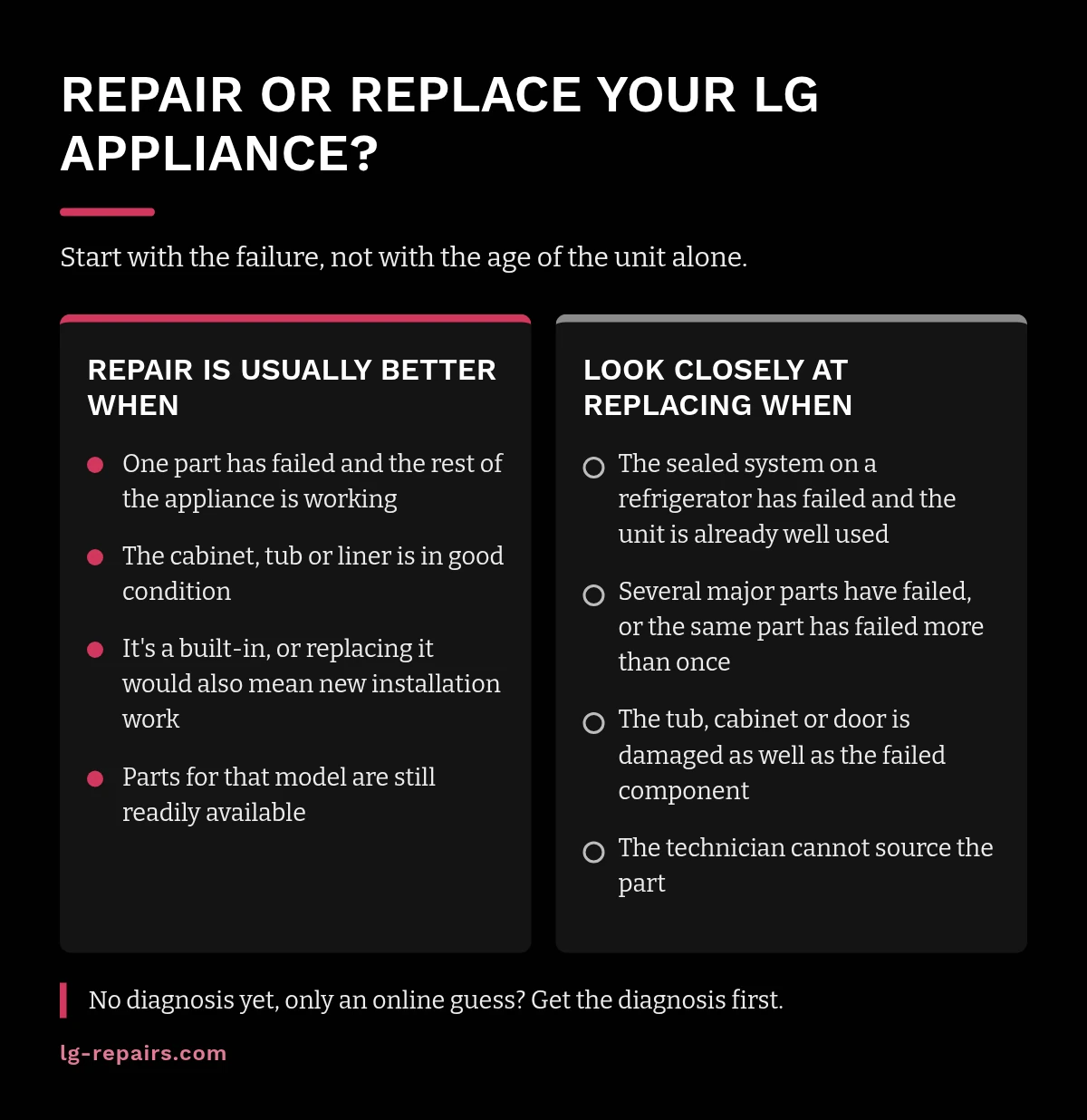
Start with the failure, not with the age of the unit alone.
Repair is usually the better path when:
- One part has failed and the rest of the appliance is working
- The cabinet, tub or liner is in good condition
- The appliance is a built-in, or replacing it would also mean new installation work
- Parts for that model are still readily available
Replacement deserves a close look when:
- The sealed system on a refrigerator has failed and the unit is already well used
- Several major parts have failed, or the same part has failed more than once
- The tub, cabinet or door is damaged as well as the failed component
- The technician cannot source the part
A useful rule of thumb is to compare the repair estimate with the cost of a comparable new unit, then adjust for installation, downtime and how the appliance has been running otherwise. If you only have an online guess and not a diagnosis, get the diagnosis first.
When does repair still make sense for each LG appliance?
LG refrigerators. A door seal, evap fan, defrost heater or start relay is almost always worth repairing. Ice maker and dispenser faults are usually in the same category. The harder case is a linear compressor or other sealed-system failure on certain French-door models. On a newer unit that is otherwise in good shape, repair can still be the right call. On an older unit, or one that has already had major work, replacement may cost less in the long run. A technician can test the sealed system and tell you which side you are on. A freezer that is iced over with a warm fresh-food section is more often a defrost problem than a dead compressor, so do not jump to replacement based on the symptom alone.
LG washers. Drain pumps, door locks, lid switches, inlet valves and belts are standard repairs. An IE or OE error often points to a fill or drain problem, not a dead machine. Front-load door gaskets that leak or hold mildew are also routinely replaced. The cases that tilt toward replacement are a failed tub bearing or spider arm on a well-used machine, or a main control board plus other damage. If the washer will not spin, have the lock assembly and drain path checked before you assume the transmission is gone.
LG dryers. No-heat problems are often a heating element, a thermal fuse or gas valve coils, all of which are normal repairs. A broken belt or a worn roller is also a repair, not a reason to replace the dryer. If the display shows an airflow error such as D-90, clean the lint screen and the vent first. A restricted vent can look like a dryer failure and is a fire hazard if you keep running it. Replacement comes into play when the motor has failed on an older unit, or when the drum support and the heater have both failed.
LG dishwashers. Poor cleaning is often a clogged filter or a spray arm that is not turning, which you can check yourself. A drain pump or a blocked hose is a standard repair. A control board on a dishwasher that also has a damaged or rusted tub is a weaker repair case, because you would be putting a new board into a cabinet that is already failing.
LG ranges and cooktops. Igniters on gas models and bake or broil elements on electric models are the most common, and most worthwhile, repairs. A single burner control or a door hinge or seal is the same story. A control board on an older range, especially if the cooktop or oven cavity is also worn, is where replacement starts to compete with repair.
What LG problems are usually a straightforward repair?
These are the faults technicians see often, and they rarely mean the whole appliance is finished:
- Refrigerator door seals, evap fans, defrost components and ice makers
- Washer drain pumps, door locks and inlet valves, including many OE and IE errors
- Dryer heating elements, thermal fuses, belts and gas valve coils
- Dishwasher filters, spray arms and drain pumps
- Range igniters and electric bake or broil elements
The fault that needs a slower decision is a sealed-system or compressor repair on a refrigerator, a tub bearing on a washer, or a control board on a unit that already has other damage. Those can still be repaired. They just need a honest comparison with replacement.
What can you safely check before you call?
Some symptoms are worth five minutes of your time before you book a visit:
- A dishwasher that is not cleaning: remove and clean the filter
- A dryer that runs long or shows an airflow code: clean the lint screen and inspect the vent
- A gas burner that will not light: confirm the burner cap is seated on the base
- Any appliance that is dead: check the plug and the breaker
- A washer or dishwasher that will not fill: confirm the water valves are open
Stop if you smell gas, see sparking, or the breaker trips repeatedly. Do not open a sealed refrigeration system or a microwave, and do not disassemble a washer tub. Those are technician jobs.
If the appliance may still be under its original LG warranty, look up the model and serial numbers and check the coverage with LG before you pay for a diagnosis. In-warranty work can change the math.
Frequently asked questions
Is it worth repairing an LG refrigerator that is not cooling?
Often, yes, if the problem is a seal, a fan, a defrost part or a start relay. A sealed-system or compressor failure on an older unit is the main case where replacement may be the better spend. A technician should test the system before you decide.
Should I repair or replace an LG washer that will not spin?
Check the door lock or lid switch and the drain path first. Those are common and usually worth repairing. A failed tub bearing or a control board on a machine that already has other problems is when you should compare the estimate with a new washer.
When should I replace a dryer that is not heating instead of repairing it?
Most no-heat faults are a heating element, a thermal fuse or gas valve coils, and those are normal repairs. Also clean the vent before you assume the dryer has failed. Replacement is more likely if the motor has failed or several major parts have gone at once.
Are parts still available for older LG models?
Parts for common repairs are widely available on current and recent models. A technician can tell you during the diagnosis if a board or a model-specific part has been discontinued. That, on its own, can settle the replace decision.
What can I safely check myself before I call?
Power, water supply, a dishwasher filter, a dryer vent and a seated burner cap. Write down any error code and the model number. Leave gas, sealed-system and high-voltage work to a technician.
Get a diagnosis before you decide
If you are stuck between repairing and replacing an LG appliance, a diagnostic visit is how you get a real estimate instead of a guess. Read more on the blog, call (877) 748-5179, or get a quote.